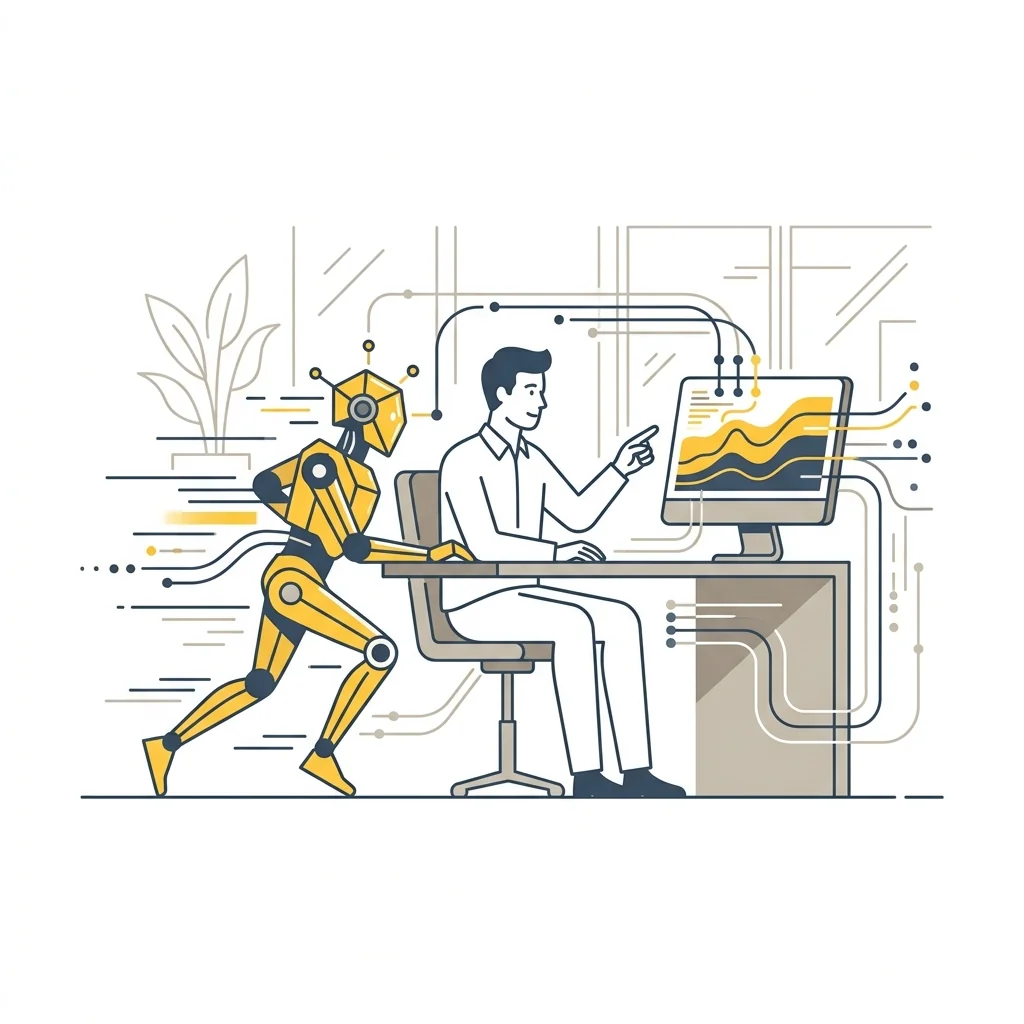
Methods for applying AI to real work, documenting the adjustments and observations from actual tasks.
For critical tasks like expense reporting and contracts, I always double-check the AI's work. For high-volume routine tasks, I first require the AI to shadow me, comparing its output against my manual results. Once the output is consistent and solidified into a Skill, I then use parallel comparison to catch exceptions. When the automated production line is stable, humans can step back into the Checker role and focus on handling exceptions.
When everyone has access to the same AI tools, workplace advantages do not come from prompt tricks or tool counts. Real professional differentiation emerges when individuals roll up their sleeves and integrate AI directly into authentic workflows.
Despite enterprise AI software procurement and high activation rates, employees often freeze when faced with an empty prompt box. Lowering the cognitive barrier and designing contextual workflow interfaces is more critical than simply distributing tools.
When faced with routine tasks, you can guide AI step-by-step, verify the results, and save the entire workflow as a Skill. Remember to include your corrections when saving it. By continuously iterating and updating to handle new exceptions, your automated workflow will become increasingly complete.
When organizations celebrate rapid task completion as proof that 'one person can do it all,' they often overlook the hidden subscription fees and personal trial-and-error costs. Treating personal AI investment as a free corporate bonus creates incentive mismatches and risks losing the invisible super users who hold the real collaboration capabilities.
High-volume routine operations with rigid business rules drain human cognitive attention and risk costly oversights when performed manually. By adapting the internal control Maker–Checker principle, organizations can assign machines to batch execution while elevating human professionals to exception handling and logic auditing.
As AI takes over writing and data processing, HR's value shifts toward task analysis, workflow design, and governance coordination. An AI Task Redesign Map helps organizations decide what to automate, where to use AI assistance, and where human judgment must remain accountable.
When HR teams deploy numerous AI tools without seeing a workload reduction, the bottleneck often stems from accumulated process patches and vague boundaries of accountability. Moving AI beyond the single-point chat window into workflow and governance architecture enables AI Agents to establish auditable, accountable, and trusted organizational capabilities.
Companies offer endless AI workshops with impressive attendance, yet employees sit frozen before empty prompt boxes. This disconnect stems from isolating learning from actual workflows. Effective enablement requires shifting from static classrooms to hands-on workflow breakdown.
When a private AI secretary fails to deliver, the root cause is rarely the tool itself. It often stems from vague prompts lacking context, format, boundaries, and actionable steps. This article outlines six key reasons for AI failure and provides an 8-question task breakdown checklist to align AI output with business needs.
Page 1 of 3