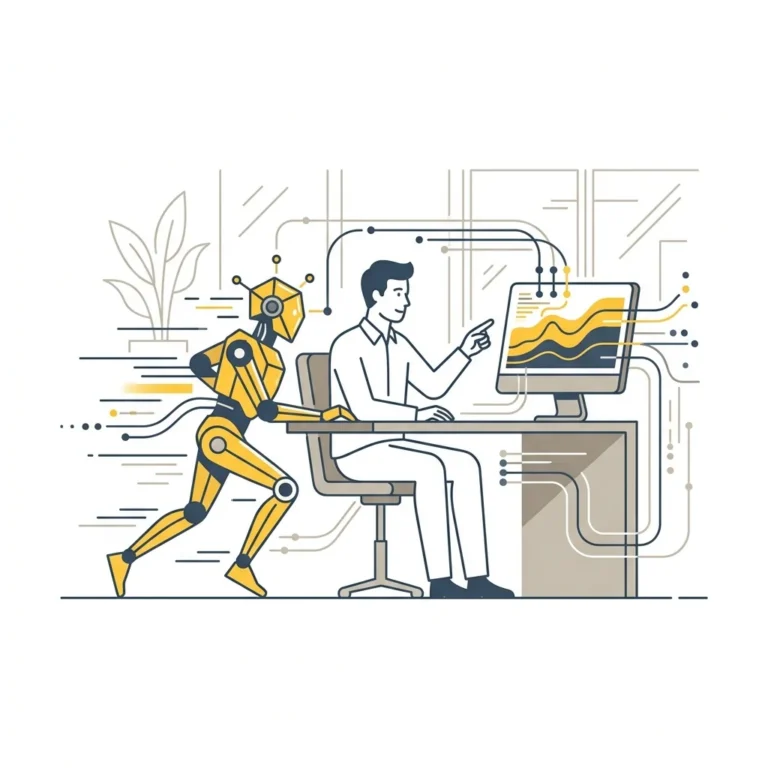
In every organization, there are routine operations characterized by high repetition, heavy time consumption, and completely fixed logic. It might be month-end reconciliation in sales, quarterly access reviews in IT, or cross-departmental list matching in compliance.
These tasks have long relied on manual handling, where missing a single record could trigger compliance or operational risks. While they should have been automated by dedicated systems long ago, they remain stuck on the desks of individual operators year after year.
In regulated industries, tracking mandatory regulatory training by HR is a prime example. Hours must be monitored, license validity maintained, and regulatory audits cleared—any oversight results in a compliance deficiency. With zero margin for error, this task has always been treated as “something that just has to be done.” The operational risk is too high to leave unattended, so manual labor continues to sustain it. Hardly anyone pauses to ask why a human has to do this in the first place.
This dilemma only found a new answer with the advent of AI. Today, business teams can write code alongside AI, building systems incrementally piece by piece. Workflows that were once too niche to justify commercial off-the-shelf software are finally getting built.
Several operational platforms in active use across my workflow were built collaboratively with AI this way—the path is proven and viable. But before diving into how such platforms work, one fundamental question must be clarified: why did no one tackle this in the past?
It is not that people failed to realize it needed automation. Such defensive, non-revenue-generating back-office tasks rarely win internal IT development priority. Commissioning a standalone software project would cost far more than having an administrator run an Excel sheet every two weeks. When the cost-benefit analysis failed to justify it, the task was deferred indefinitely. Administrators simply opened Excel and re-ran the same manual cycle of export, cross-reference, and notification.
Tracking statutory training was one of those tasks.
Hundreds of Individuals Mean Hundreds of Rolling Expiry Dates
In statutory training tracking, administrators must export personnel rosters from internal HR systems, cross-reference training hours from external accredited institutions, calculate deficits, and send reminder emails.
Regulations are unambiguous. For trust enterprise specialists, regulations stipulate at least 18 hours of on-the-job training every three years, with at least one-third conducted by accredited industry associations; failure to comply disqualifies the individual from continuing in their role.2 The statutory clause contains no ambiguity—hours, timelines, and consequences can be stated in a single sentence.
The true operational friction lies in individual variation. Compliance cycles start from an individual’s registration date—some on February 1, others on March 5—each with their own rolling 3-year deadline. With hundreds of employees on the roster, there are hundreds of distinct deadlines. The required data columns are few: registration date, expiry date, completed hours, and resignation status. The difficulty is that every single row is dynamic. Personnel transfer, hours accrue, and expired cycles restart.
In the past, organizations relied entirely on Excel formulas. Identifying whether a listed employee had resigned required line-by-line manual verification. When this cycle recurred every two weeks, enormous cognitive effort was drained.
Such fixed-logic operations are ideal candidates for system automation. Clear rules allow automated engines to compute status and dispatch notifications. While many acknowledge this conceptually, operations remained trapped in Excel until AI lowered the software development barrier.
However, most people’s first instinct is still to optimize Excel: asking AI to generate better formulas or write macros. The underlying tool remains unchanged, and AI merely makes spreadsheets slightly smoother. Taking this path leaves the repetitive manual workflow untouched.
The genuine breakthrough is transforming rules into an autonomous operational platform where code executes the entire end-to-end process. Clarifying this workflow allowed me to build the platform step by step with AI. Aggregating training records, cross-referencing hours, and dispatching notifications were all offloaded to the platform, with a clean dashboard highlighting incomplete training at a glance. Without waiting in IT queues, frontline administrators who understand the business best could build the solution themselves.
The true shift was in the operating model. Rather than manually handling raw spreadsheets, opening the platform presents pre-computed, verified results. Human roles shifted from processing all data and checking it manually to managing exceptions only.
Machine as Maker, Human as Checker: Where Do People Stand?
graph TD;

subgraph S1["Machine Side: Maker (Batch Processing & Automation)"]

A1["Import Personnel Lists & Training Hours"] --> A2["Rule Engine Matching (Registration, 3-Year Deadline, Resignation Flags)"];

A2 --> A3["Automated Notification Dispatch"];

A2 --> A4["Real-Time Dashboard & Exception List Generation"];

end;
subgraph S2["Human Side: Checker (Exception Management & Risk Ownership)"]

B1["Verify Edge Exceptions (Resignation Flags, Case Accommodations)"];

B2["Audit Underlying Logic (Data Format Changes, Statutory Revisions)"];

B3["Sign-off Statutory Audit Reports & Governance Accountability"];

end;
A4 -->|Aggregate Exceptions & Metrics| B1;

A2 -.->|Audit Execution Rules| B2;

B1 --> B3;

B2 --> B3;
The core principle of Maker–Checker is straightforward: separating the executor from the verifier to eliminate single-point operational errors and fraud risk.1
Transforming regulatory training into a platform shifts the Maker role to machines. By borrowing this principle of separating execution from validation, workflows are restructured: machines handle execution and baseline checks, while humans manage exceptions and assume governance responsibility.
Machine as Maker, Human as Checker.
Strictly speaking, human professionals are no longer line-by-line checkers in the traditional sense. Relying on human visual attention to police hundreds of static data points is not a sustainable control mechanism. Human attention inevitably degrades over time—it was never meant to serve as a batch processing engine. Conversely, high-volume, repetitive, rule-bound, and verifiable tasks represent what machines do best. As machines assume execution, humans step back into roles of exception management and governance accountability. Operational focus moves from manual row-by-row arithmetic to assessing whether algorithmic outputs adhere to business intent: verifying whether resignation filtering missed edge cases, checking notification delivery targets, ensuring deadline algorithms remain robust across calendar years, and ultimately signing off on official lists during regulatory audits.
However, while this division sounds intuitive, key governance boundaries must be observed.
First, applicability scope must be evaluated. This division only functions where operational rules are explicit. Regulatory hours and deadlines can be codified for machines; subjective accommodations for disputed cases cannot and must not be delegated to automated code.
Second, error modalities differ fundamentally. In manual workflows, errors are typically isolated typos or skipped rows that can be corrected individually. But if platform logic contains a flaw, every single record processed under that rule will be incorrect—and with such uniformity that it becomes harder to detect. Checkers must therefore audit systemic execution logic rather than individual records, focusing sampling efforts where logic is most vulnerable, such as upstream data schema changes or regulatory threshold adjustments. Machine execution raises the bar for human governance rigor.
Finally, maintenance costs versus operational frequency must be weighed. Platforms require ongoing maintenance when regulations or data schemas change. The decision hinges on scale and cadence. For a team of dozens evaluated quarterly, standard spreadsheets with rigorous discipline suffice; building an automated platform creates unnecessary overhead. But when rosters exceed hundreds of employees and recur bi-weekly, upfront development effort amortizes rapidly across cycles, delivering clear governance and productivity value.

Digitalization Begins with Core Operations, Tools Come Last
Discussions around human-AI collaboration often focus on prompt-based conversational outputs. An alternative path is turning manual routines directly into autonomous platforms. The former requires human initiation on every invocation; the latter allows operational personnel to step back into the supervisory Checker role permanently.
Tools come last. First, lay out existing workflows, dissecting which steps can be codified for machine execution and which demand human judgment. Only once these boundaries are defined should one select AI, Python, Power Automate, or other toolsets.
Actionable Steps to Test in Your Workflow
- Identify a routine spreadsheet requiring recurring execution, outline every operational step as a single line, and categorize each as either “rule-based computation” or “human judgment.”
- Focus on steps marked as “rule-based computation” and formulate them into explicit conditional statements. If they can be formulated cleanly, they belong to the machine Maker; if not, they remain in the human domain.
- Pass structured logic to coding AI assistants like Codex or Claude to plan automated workflows. Develop incrementally and validate outputs after each section. You do not need an engineering background—letting AI guide the build delivers immense practical value.
The next time you face a recurring bi-weekly task, resist asking how to do it faster.
First ask: Does this task still require a human to serve as the Maker?
If you are restructuring internal workflows or exploring practical AI implementations, you can find more methods and observations on human-AI collaboration in Field.
Further Reading
- Next Step for HR AI: From Tool Demonstration to Workflow Reconfiguration
- AI Agent Field Notes: Bridging Workflow Disconnections to Reclaim Focused Time
References
-
Wikipedia, “Maker-checker”, Wikipedia entry on the four-eyes dual authorization control principle in enterprise information systems. Used for workflow definition without statistical claims. https://en.wikipedia.org/wiki/Maker-checker ↩
-
Standards Governing Qualifications and Experience of Responsible Persons and Specialists of Trust Enterprises, Article 16, Laws & Regulations Database of The Republic of China (Updated August 7, 2026). Cited for statutory hours, accredited ratios, and compliance consequences as an example of unambiguous regulatory rules. https://law.moj.gov.tw/LawClass/LawSingle.aspx?pcode=G0310037&flno=16 ↩
Frequently Asked Questions
What is the "Machine as Maker, Human as Checker" model in routine operations?
It delegates fixed-rule, high-volume repetitive tasks—such as schedule tracking, data reconciliation, and automated notifications—to machines Maker, while elevating professionals Checker to exception handling, systemic logic auditing, and governance accountability. Why is manual row-by-row roster checking unsustainable? | Human cognitive attention degrades when forced to act as a batch calculation engine over repetitive records, inevitably causing missed details. Rule-based automation ensures consistency and zero oversight. What operational workflows justify building an automated platform? | Workflows characterized by high frequency e.g. bi-weekly cycles and large scale hundreds of records with clear verifiable rules. For smaller teams evaluated infrequently, spreadsheet templates are more cost-effective. What is the biggest operational risk when machines act as Makers? | Systematic error propagation. Flaws in calculation logic or changes in upstream data formats impact every record uniformly, making them harder to spot than isolated human typos. Checkers must focus on auditing core logic.
Four Steps to Reconfigure Human-Machine Routine Workflows
-
Map Existing Workflow
Dissect the recurring operational routine into a granular list of individual steps. Tag Rules vs Judgment | Label each step as either "rule-based computation" or "human discretion/judgment." Extract Explicit Conditions | Formulate the rule-based steps into clean, testable logic statements. Build Incrementally with AI | Use coding AI assistants to architect automated workflows, developing and validating step by step.