

What Interviews in Conference Rooms Can’t Capture
After a recent training session in the financial industry, a senior manager came up to ask: “Given all the digital and AI results you’ve achieved, which consulting firm did you bring in?”
I told him: none. He was visibly surprised.
At least for this entire digital workflow and platform — from design to build to rollout — no external consultants were involved. My team and I built it, step by step.
This reaction is perfectly normal. In the financial industry, where companies heavily rely on external consultants for advice and direction, assuming consultants were behind the work is only natural.
However, years of experience in digital transformation have taught me that when organizations depend heavily on external teams, the results usually hinge on whether someone internally can reshape processes and integrate AI and digital tools with existing workflows.
If consultants are involved, the best collaboration model combines the internal expert’s “local experience” with the consulting firm’s “cross-industry perspective.” External consultants bring irreplaceable value: exposure to many companies, mature methodologies, and fresh perspectives that can challenge teams.
Yet for these two sides to connect, they must bridge an information gap — the unspoken “know-how” that only insiders understand.
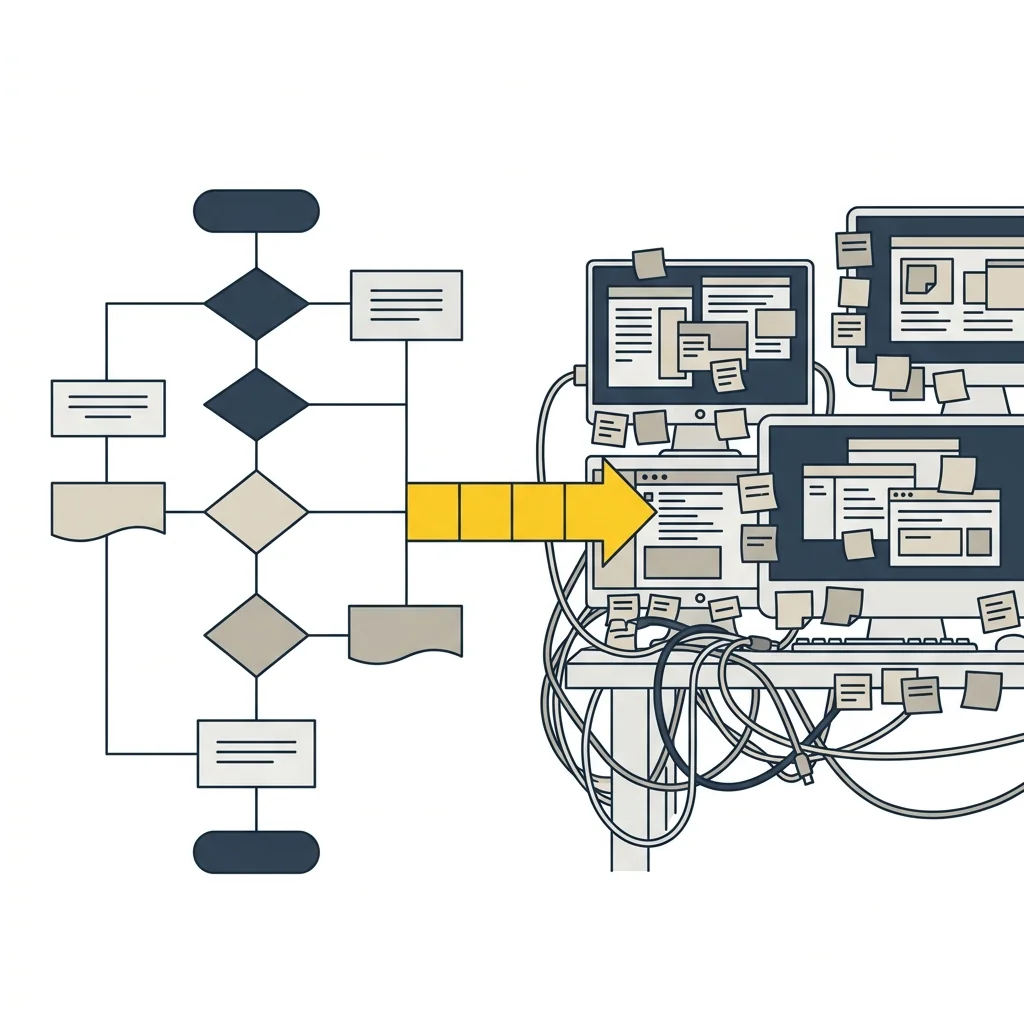
This is fundamentally a contextual disconnect between the two parties. When people sit in conference rooms facing external experts, they typically present the standard answer of “how things should work” according to process diagrams. The workarounds developed for handling exceptions or navigating cross-departmental cooperation have long been internalized as daily reflexes. These are so natural to practitioners that they would never think to mention them in interviews. Without this hidden context, external teams can hardly identify the real business logic behind the detours. But open up the system, and the actual operational practices usually reveal an entirely different world.
Academia has a concept called “tacit knowledge” that helps explain this kind of inexpressible experiential judgment, intuition, exception handling, and rapid situational understanding1. The reasons processes break down are often buried here.
External teams can bring excellent technology and advice, but whether these frameworks actually land depends on whether someone inside can translate those unspoken needs into instructions the system can understand. External resources can supplement methodology and technology, but someone internal must take responsibility for scenario definition and process redesign.
The Cross-Domain Pioneers Who’ve Been Quietly Testing New Tools
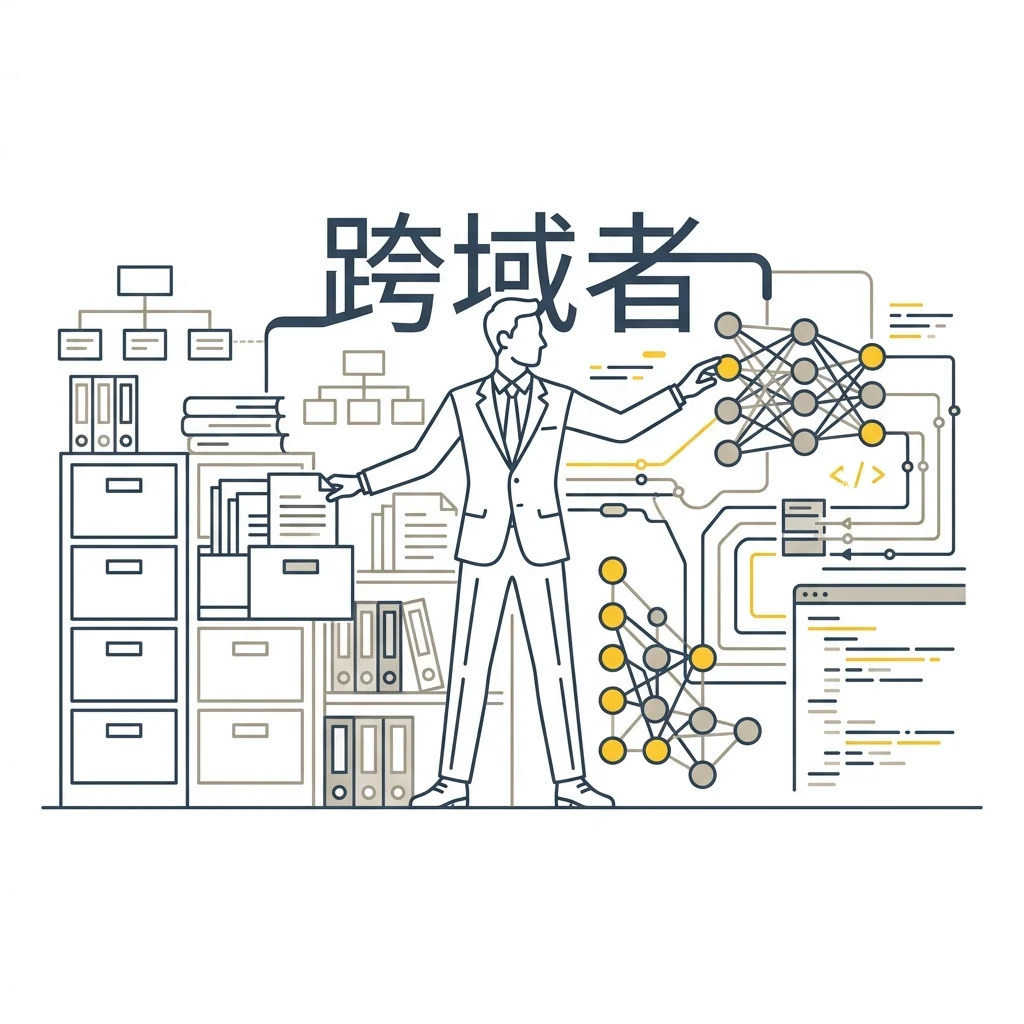
What keeps AI alive in an office? A group of pioneers who understand internal unwritten rules and aren’t allergic to new technology. In various contexts, this role resembles an analytics translator, domain owner, product owner, or boundary spanner. I’ll call them “double-hatters” for now, because they live simultaneously in both the business and technology worlds. McKinsey’s description of analytics translators emphasizes that they must connect AI and data understanding with business objectives, and domain knowledge is a critical factor. Since external talent often lacks internal company context, training existing employees tends to have a better chance of success.
These people are scarce because the demands of both domains tend to be mutually exclusive by nature.
Management theory has a classic concept called the “Competency Trap”2. It reminds us that organizational resistance to new methods often stems from the fact that existing approaches once worked and still deliver acceptable performance. When a set of practices continues to produce stable output, organizations naturally refine the existing model, reducing their motivation to explore alternatives.
In the context of AI adoption, this phenomenon is clearly visible. The longer someone has been on the business side, the more familiar they become with existing processes, exception handling, approval logic, and organizational taboos. Their judgment tends to be more mature, and they understand the necessity of maintaining current operations. The trade-off is that when new tools emerge, they’re likely to evaluate them by the standards of existing processes first. When senior managers hear about new technology, their first reaction is often: “Is this stable? Can we trust it?”
This defensive posture is fundamentally about risk management. Trying new methods means a team that was proficient temporarily becomes unproficient, and previously predictable output gains new variables. In the interest of protecting existing delivery quality, it’s easy to underestimate the potential of new tools to rewrite how work gets done.
What about IT or digital staff who specialize in technology? They’re generally more familiar with technological changes and quicker to see a tool’s potential. Many companies do expect IT to lead the AI charge — being closest to the technology, shouldering this responsibility sounds perfectly logical.
But the institutional role assigned to IT within the organization often doesn’t align with this expectation. In many large organizations, IT’s daily tasks have long centered on stability, information security, compliance, and delivery. Their KPIs require them to prioritize system availability and compliance above all else. When leadership simultaneously expects this department to spearhead AI exploration, two competing logics press down on the same group of people, making conservatism almost an inevitable outcome. Compounded by late entry into projects, IT often gets forced into the ticket-processing mode, unable to participate early in defining use-case scenarios. Without long-term collaboration alongside frontline workers, IT can’t easily understand the accountability structures, risks, and interpersonal dynamics behind each request ticket. They can see system efficiency but struggle to grasp how a change might affect the frontline’s existing interests and sense of security.
Moreover, crossing into either domain has its challenges. For business people to cross into technology, the barrier is hard skills; for IT to cross into business, they need time to understand accountability logic and organizational order.
Even if someone does survive both learning curves, the real test has just begun. Merging these two worlds requires a third, extremely hard-to-acquire piece of the puzzle: process and experience design.
Understanding both technology and business still doesn’t guarantee creating something people will actually use. If an AI tool improves computational efficiency but forces frontline workers to add three extra steps to their operations, adoption rates will be noticeably affected, and frontline workers are more likely to develop workarounds. Double-hatters must possess the ability to “reshape how work gets done” — deconstructing business logic, reconnecting it with new technology, and folding rigid systems seamlessly into daily operations to minimize frontline friction. This is the key to crossing the practical threshold.
This is also why double-hatters are so scarce. Most companies’ organizational structures and divisions of labor inherently separate these professional domains. Concentrating business understanding, technical capability, and experience design in a single person is genuinely rare in any organization. But transformation success can’t depend on waiting for a few geniuses to emerge. The true value of double-hatters is serving as “node figures” in transformation. Enterprises must align business, IT, legal compliance, information security, and HR into a shared governance mechanism, giving double-hatters a stage to perform on. Only then can transformation evolve from individual heroism into sustainable organizational capability.
A 2001 Harvard Business Review article pointed out that when pushing radical organizational change, middle managers’ contributions are often underestimated by senior leadership. In reality, they are frequently the key drivers of change because they know how to leverage informal networks and emotional support to defuse resistance3. Applying this concept to AI adoption, these transformation champions are precisely the double-hatters who must simultaneously hold “internal trust” and “cross-domain vision.” When the boss talks strategy, they can tell which statements are lip service and which are serious; when frontline staff report system pain points, they know how to package them into risks that the boss will actually hear. They speak both languages fluently.
This is also why external consultants can hardly replace them. Consultants can bring best practices, but the hidden contexts within an organization — “why this process can’t be changed,” “why a certain manager will oppose this” — can only be untangled by double-hatters who have been embedded in the system long-term.
How Performance Reviews Are Scored Determines Whether These People Survive
Double-hatters’ cross-domain capabilities are inherently difficult to cultivate. But the reason they remain absent may not solely be about scarce capabilities — the more critical factor is the asymmetry between risk and reward. Most enterprises’ current performance evaluation systems are systematically constraining the survival space of these people.
Clayton Christensen noted a phenomenon in The Innovator’s Dilemma: excellent companies miss the next wave often because they executed existing processes and resource allocation logic too perfectly, making them blind to disruptive innovation4. AI adoption may not always fit the strict definition of disruptive innovation, but it does challenge existing processes, performance metrics, and resource allocation.
Extending this logic to individual behavior within enterprises, this dilemma plays out on employees’ performance reviews every single day. The core philosophy of most companies’ KPI designs centers on “steadily completing existing tasks.”
Under this evaluation logic, if an employee spends an afternoon researching a new AI tool to automate a report, this effort usually can’t be quantified as a performance bonus. Sometimes it’s even questioned as straying from core responsibilities. Wanting to do more and optimize processes rarely receives proportional recognition, but if trying a new tool affects original delivery quality, the employee must bear enormous pressure.
When systemic design inadvertently raises the cost of “deviating from existing processes,” rational employees will naturally choose self-preservation. After all, managers are protecting departmental delivery and accountability; employees are protecting their performance ratings and job security. Business-savvy people don’t want to move because their performance is entirely tied to old processes; tech-savvy people want to push forward but can’t, because frontline workers won’t risk making mistakes just to help them test new tools.
So if leadership’s transformation initiatives lack supporting mechanisms, as long as the foundational organizational operating logic remains unchanged, new tool deployments will face enormous resistance on the frontline.
In this “do more, fail more” atmosphere, even if a company does harbor a few people with double-hatter potential, they’ll usually choose to stay silent. Caught between technology and business, stepping up to help the company push transformation means shouldering enormous communication costs and blame risks. Rather than being an unappreciated first-mover, it’s safer to keep quiet and hit their KPIs. This is an important reason why double-hatters remain invisible in many enterprises.
Reconfiguring Responsibilities So Seeds Can Sprout
Since “do more, fail more” performance systems force double-hatters into invisibility, leadership’s solution can’t simply be pushing transformation responsibilities outward.
Some companies choose to bring in a parachuted Chief Digital Officer (CDO) to drive transformation, but a parachuted CDO lacking internal authorization, business trust, and process understanding can easily become a fracture point between leadership’s vision and on-the-ground reality. When the core operations team sees it as just another disconnected initiative, proposals tend to stall at the presentation stage. At that point, the priority should shift back to adjusting the internal conditions that constrain innovation.
The most critical step is incorporating controlled pilots into formal output. Since everyone cares about KPIs, enterprises must let employees know that exploration and experimentation need to be placed within clear governance mechanisms. Especially in the financial industry, double-hatters cannot be understood as innovation privilege-holders who bypass the system. What they truly need is an authorized, documented, and audited safe experimentation space.
Every AI pilot should first clearly define data classification, access permissions, model output usage, human review methods, anomaly reporting paths, and exit conditions. When external tools or third-party services are involved, outsourcing management, information security, and legal compliance reviews must also be incorporated. This way, innovation doesn’t require covert risk-taking, and risks aren’t dumped on the frontline to shoulder alone. The value of double-hatters lies precisely in building a replicable safe pathway for the organization between business needs, technical feasibility, and governance boundaries. Even if results aren’t immediately successful, they’ll be viewed as manageable organizational exploration outcomes.
Beyond performance reviews, the timing of IT-business collaboration also needs redesigning. When the system positions IT purely as maintenance and ticket processors, KPIs naturally push them toward conservative control. True business authorization means letting IT enter business scenarios earlier, inviting technical personnel to observe firsthand how the frontline actually operates and what they worry about, transforming them into co-designers of transformation.
Creating opportunities for cross-domain collision is equally important. Most companies’ departmental walls inherently prevent the emergence of double-hatters. Let developers go to the frontline to watch how business teams handle customer complaints, or let senior business staff personally test automation tools. This kind of close-range friction is an important pathway for cultivating “process and experience design” capabilities.
flowchart TD

    %% Define Styles

    classDef default fill:#F8F9F9,stroke:#2C3E50,stroke-width:1px,color:#2C3E50;

    classDef highlight fill:#F1C40F,stroke:#2C3E50,stroke-width:2px,color:#2C3E50;

    classDef safezone fill:#FFFFFF,stroke:#2C3E50,stroke-width:2px,stroke-dasharray: 5 5,color:#2C3E50;
    subgraph Governance ["Cross-Departmental Governance Boundary"]

        B[Business Dept
Scenarios & Acceptance]

        I[IT Dept
Tech Resources & Security]

        C[Compliance / HR
Compliance & Performance]

    end
    subgraph SafeZone ["Safe Pilot Zone"]

        D((Double-hatter)):::highlight

        P[Process Redesign & AI Pilot]

    end
    B --> D

    I --> D

    C -.->|Authorization & Protection| D

    D --> P

    P -->|Successful Practices| O[Replicable Organizational Capability]
    class SafeZone safezone;
A Colleague’s Demonstration Matters as Much as the Boss’s Orders
When double-hatters finally fold rigid technology seamlessly into existing workflows, the next challenge is getting the whole company to buy in.
According to Everett Rogers’ diffusion of innovations theory, the adoption speed of new tools largely depends on their “observability.” MIT research in social physics echoes this direction: ideas and behaviors often spread through social networks and peer interaction5. Leadership’s directives can create legitimacy and resources for transformation. At the same time, peer demonstration typically reduces users’ psychological risk more effectively than one-way promotion. For most frontline employees, “my colleague next door is already using this tool and leaving early” — this kind of live demonstration builds internal trust more effectively. The combination of both can drive company-wide adoption.
Many expensive “AI demonstration projects” executed by external teams ultimately end up being just that — demonstrations. They may prove the technology’s power but fail to pave a path that everyone feels safe stepping onto.
Returning to the original question: “Which consulting firm should we hire for our AI transformation?”
One of the most common misjudgments in enterprise AI transformation is treating it as a technology project that can be entirely outsourced. External consultants provide value through vision, methodological frameworks, and governance benchmarks. At the same time, what determines how far transformation goes is whether someone inside the company is willing and brave enough to reshape existing processes.
External frameworks and system vendors’ technical firepower are important assets, but smoothing out the complexities of office operations still requires internal champions to coordinate. If your enterprise is struggling with what to do next, start by re-examining internal responsibility allocation. Look at those employees who like writing small scripts and are always seeking to optimize processes — how are their performance reviews scored? Are their managers giving them space to experiment with new workflows within controlled risk boundaries?
Shifting the perspective back to HR, who are responsible for organizational development: driving AI transformation is far more complex than running a few training sessions or purchasing software. You need to uncover the cross-domain talent hidden across departments, grant them formal authorization, and ensure that their trial-and-error within safe boundaries genuinely translates into performance ratings. Systematically, you must also allow these people to move freely between business, IT, and legal compliance departments, distilling frontline experience into standardized practices everyone can use. Once double-hatters have clear recognition, fair evaluation, and a clear understanding of where risk boundaries lie, transformation can escape the predicament of relying on a few passionate individuals and truly become portable organizational capability.
The answer to whether transformation can land has always been right there in your office.
References
Further Reading
- The Motor and the Old Belt: Cognitive Traps in Enterprise AI Transformation and the 50-30-20 Rule
- The Efficiency Trap: Why Organizations Become More Complacent When AI Increases Efficiency?
FAQ
Q: Why can’t enterprise AI transformation be completely handed over to external consultants?
A: External consultants can provide methodologies and technical architectures, but they lack internal tacit knowledge and process context, making it difficult to identify exception handling and responsibility logic in actual operations, which leads to implementation failures.
Q: What are “double-hatters,” and what role do they play in AI transformation?
A: Double-hatters are internal promoters who are familiar with both business processes and new technological tools. They can translate frontline experience into system instructions and coordinate among business, IT, and compliance departments.
Q: Why can’t the IT department lead AI transformation alone?
A: The institutional role of IT has long revolved around stability, security, and compliance, with KPIs prioritizing system availability. When executives simultaneously expect them to explore AI, the two logics conflict, making conservatism the inevitable result.
Q: What should enterprises do to encourage double-hatters to step forward?
A: Incorporate controlled pilots into official outputs and performance reviews. Establish an authorized, recorded, and audited safe testing ground so innovation doesn’t rely on private risk-taking, allowing trial-and-error results to become manageable organizational exploration outcomes.
Q: Why is peer demonstration important in promoting AI?
A: According to diffusion of innovations theory, the adoption speed of new tools depends on observability. When frontline employees see their colleagues actually using AI tools to improve efficiency, it reduces psychological resistance more effectively than one-way top-down communication.
-
Michael Polanyi proposed in The Tacit Dimension (1966) that “we can know more than we can tell” (his thinking also continued from Personal Knowledge), making it a classic starting point for exploring tacit experience and frontline judgment. ↩
-
The “Competency Trap” was proposed by Levitt and March in their 1988 paper Organizational Learning. Organizational learning has a tendency to rely on historical routines; when a set of practices with acceptable performance continues to accumulate experience, organizations become reluctant to learn potentially better new methods, ultimately trapped by their own “competence.” (PDF backup link) ↩
-
Quy Huy’s 2001 Harvard Business Review article In Praise of Middle Managers pointed out that middle managers make important contributions to radical change, contributions that are largely underappreciated by senior leadership. They are effective allies in driving change and key to translating strategy into frontline action. For emotional balancing and change adaptation, see also Huy’s 2002 research. ↩
-
Clayton Christensen’s The Innovator’s Dilemma noted that mature companies channel resources into sustaining innovations valued by existing customers, becoming blind to disruptive innovations that initially appear unprofitable and niche. (Extended reference: Christensen Institute’s definition of disruptive innovation) ↩
-
Everett Rogers’ Diffusion of Innovations noted that “Observability” influences innovation adoption speed; Alex Pentland’s Social Physics explains that ideas and behaviors flow through social networks. Together, these support this article’s judgment: when promoting AI adoption within enterprises, peer demonstration often reduces the frontline’s psychological risk more effectively than one-way communication. ↩


