After implementing AI training, companies often assess whether their employees possess AI capabilities. HR distributes surveys, L&D arranges courses, and managers require team members to obtain certifications. The result is usually a checklist detailing who has taken classes, who can use Copilot, or who can write clear prompts.
However, returning to daily departmental operations, employees are often hesitant to use these new tools. Their concerns include: Which documents can be uploaded? How is ownership of AI-assisted outputs determined? Where does the liability fall when the content is incorrect?
Without clear guidelines on these conditions, AI skills struggle to enter formal workflows. Team members will typically restrict AI usage to trivial tasks or use it privately without supervision. Solely assessing individual capabilities overlooks the significant impact of work design.
How Process and Organizational Conditions Determine Skill Utilization
graph TD

    A[Drive AI Training] --> B[Assess Individual Tool Skills]

    A --> C[Assess Organizational Process Conditions]
    B --> B1[Distribute Surveys / Arrange Courses]

    B1 --> B2(Overlook Work Design)

    B2 -.-> B3((Employees Hesitate in Formal Tasks))
    C --> C1[Clarify Data Boundaries / Permissions]

    C --> C2[Reshape Performance Evaluation / Gain Managerial Support]

    C1 & C2 -.-> C3((AI Skills Truly Integrate into Daily Workflows))
    style A fill:#f9f9f9,stroke:#333

    style C fill:#fff2cc,stroke:#d6b656,stroke-width:2px

    style C3 fill:#e1f5fe,stroke:#0288d1
The CIPD’s 2026 AI skills planning guidance starts by advising organizations to first assess their risk and governance status, secure managerial endorsement, and establish sandbox environments and data boundaries for early adopters. The guidance firmly places the focus on organizational conditions. 1
When AI skills are applied to actual work, they immediately encounter challenges relating to permissions, data control, performance evaluation, and existing management habits. Learning to use AI to write client meeting summaries is a skill enhancement. Returning to existing processes, however, requires clarifying who confirms the confidentiality level of the meeting notes, who reviews the output, how sensitive information is masked, and where the final version is stored.
Past skills assessments have focused on tool familiarity and subsequent training needs. For AI skills, the core evaluation should be: Once a team member learns AI, what changes will occur in their assigned tasks? Do formal processes permit the introduction of AI? Will their manager understand the new approach? If AI saves two hours, how should the freed-up time be reallocated?
These questions intersect with the managerial responsibilities of business units and directly affect the outcomes of AI training. Microsoft’s 2026 Work Trend Index points out that organizational factors—such as company culture and managerial support—determine the actual impact of AI more than an employee’s individual mindset. The report describes a group of “blocked agency”: individuals who possess adequate capabilities but are unable to perform because the organizational conditions are not yet ready. 2
The IT department issues bans to prevent data leaks; the compliance department needs to track liability but lacks involvement in process discussions; managers, unsure how to evaluate new methods, demand that team members revert to old standards. Even if the HR department completes training and surveys, the organization’s operations remain unchanged.
Skills Planning is a Cross-Departmental Governance Task
BCG notes that many enterprises simply layer AI on top of old processes. Employees use it regularly, yet there is a lack of discussion on adjusting roles, performance metrics, and collaboration methods. 3
Skills planning is a cross-departmental endeavor. HR needs to collaborate with business leaders, IT, and compliance departments to clarify several prerequisites: Which tasks allow employees to introduce AI testing? What data is strictly prohibited from being uploaded to the cloud? During a manager’s review, do they need to inspect the employee’s problem-definition process? For team members highly proficient in AI, is the performance standard based on increased output volume, or on handling more complex judgments?
Depending on each company’s data sensitivity, the answers will vary significantly. Without these discussions, employees will revert to old methods after training. Those familiar with AI will turn their capabilities into personal habits, making it difficult for the organization to retain and scale these experiences.
AI skills planning needs to be integrated with risk governance. The NIST AI RMF breaks risk management down into four functions: govern, map, measure, and manage, emphasizing its continuous operational nature. 4
In daily work, this means ensuring employees clearly know what matters can be tested, what actions require prior approval, which outputs must be reviewed, and what records must be retained.
Writing prompts is a skill, and employees also need to understand data boundaries, debugging methods, and reporting responsibilities. Managers must also possess this awareness, as their attitudes determine which AI applications are encouraged and which practices are suppressed. If a manager verbally supports AI but evaluates performance based on traditional output standards, employees will lean towards using old methods to complete tasks.
AI skills influence how work is defined, how results are calculated, and how risk is borne. This is the entry point where the HR department can exert its influence.
Evaluating Process Capacity from the Work Context
When conducting AI skills assessments, you can add this question: “In your current tasks, which item did you want to use AI for, but paused due to process or permission concerns?”
This question brings the focus back to practical workflows. Employees’ concerns might include the handling of sensitive data, managers’ acceptance of AI-generated styles, or the lack of suitable channels for reporting and discussion. These responses help the organization clarify the restrictive conditions of AI applications. Barriers may stem from permission settings, management’s acceptance levels, or employees’ fears regarding liability.
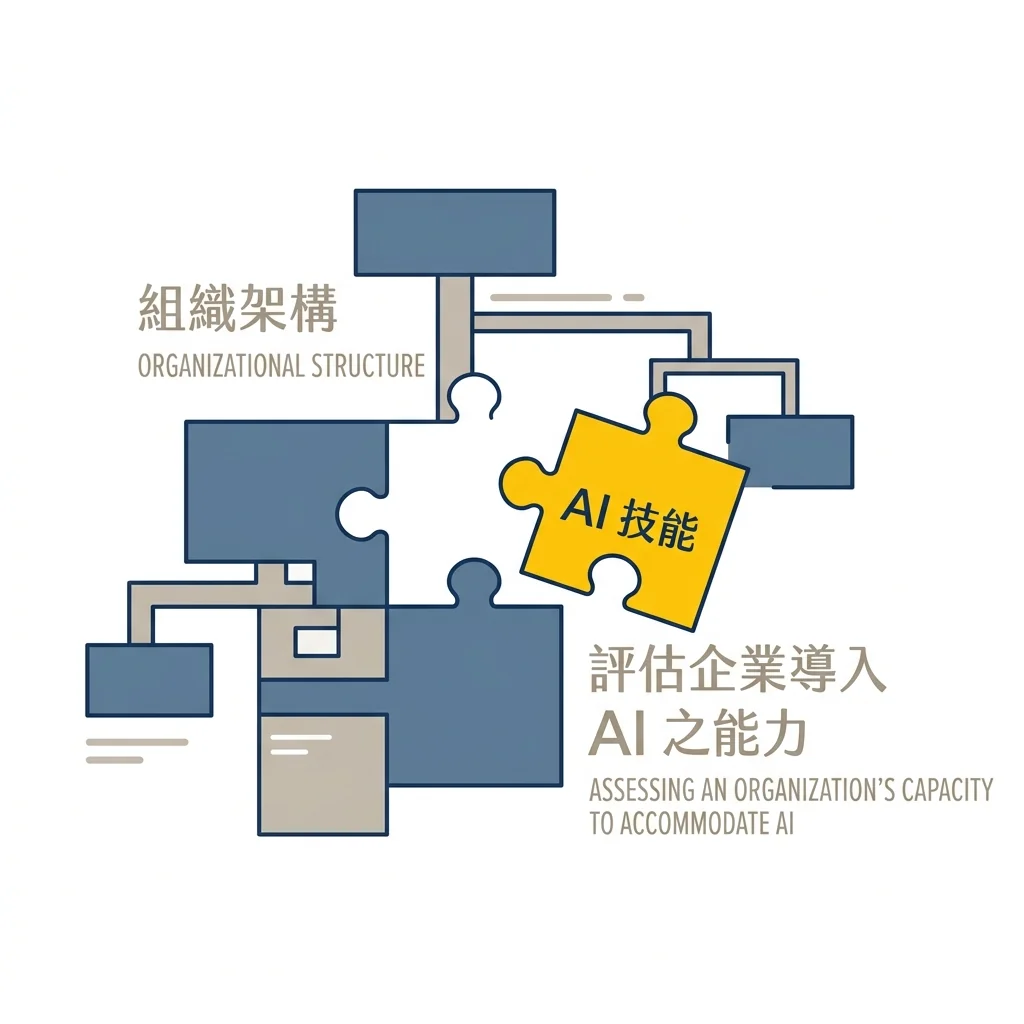
Skills assessment simultaneously tests the degree to which an organization’s existing processes can accommodate new ways of working. Expecting to integrate AI capabilities into daily work requires first assessing the capacity of existing processes and the readiness of management.
When planning training or skills assessments, try adding this checkpoint:
- Uncover restricted application needs: Ask team members to provide a specific task with AI application potential that cannot be executed due to process or permission constraints, and label the restrictive factors (e.g., data sensitivity, managerial attitude, system permissions).
This information helps focus on the process limitations the organization must prioritize solving.
References
Further Reading
- The Next Step for HR AI: From Tool Demos to Workflow Redesign
- The Future of HR with AI: From Human Resource Management to Organizational Capacity Design
- The Bottleneck of Enterprise AI Transformation: When KPIs Precede Application Scenarios
- AI Agents Enter the Workflow: Enterprises Must First Design Human-Machine Handoff and Evaluation Infrastructure
-
CIPD, AI skills planning: Practical guidance for people professionals, 2026-04-14. ↩
-
Microsoft WorkLab, 2026 Work Trend Index: Agents, human agency, and the opportunity for every organization, 2026-05-05. ↩
-
BCG, As AI Changes Work, CEOs Must Change How Work Happens, 2025. ↩
-
NIST, AI RMF Core, based on AI RMF 1.0. ↩
-
Stanford HAI, 2026 AI Index Report, 2026. ↩
Frequently Asked Questions
Why is it insufficient to only assess employees' AI tool proficiency?
Because when employees return to their daily tasks, they often face process barriers such as data upload restrictions, unclear permissions, or outdated managerial assessment standards, which prevent them from applying AI skills in formal workflows. Which departments should be involved in AI skills planning? | AI skills planning is a cross-departmental governance task. HR must collaborate with business leaders, IT, and legal compliance to establish data boundaries, trial scopes, and risk management mechanisms. How can organizations evaluate their process readiness during a skills assessment? | Organizations can ask employees: "In your current tasks, where did you want to use AI but stopped due to process or permission concerns?" to identify and resolve process bottlenecks.