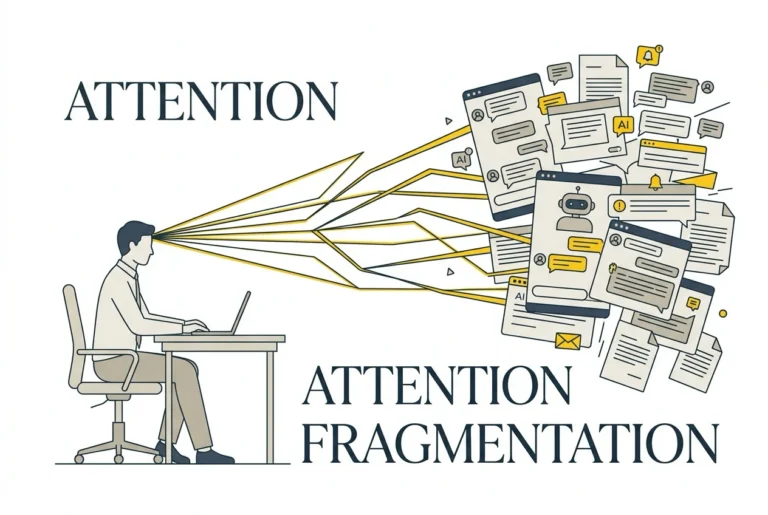
When a company first pushes into digital transformation or AI, the person who moves first often runs straight into “capability burnout.” Run too fast, and the organization’s friction concentrates on you — in an environment of strict review, low error tolerance, and unsettled responsibilities, the first mover carries pressure wildly out of proportion to everyone else’s.
The Faster You Run, the More Responsibility Lands on You Alone
Before the rules are settled, whoever brings in the new tool tends to own every problem it touches.
Most people’s understanding hasn’t caught up yet, and the safest way to avoid unknown risk is to push every operational problem back onto the person who started it. Worse, a new workflow has no track record to vouch for it, so even a tiny flaw gets magnified in routine review.
This is really self-protection under performance pressure. In mature organizations, the penalty for mistakes usually far outweighs the reward for improvements; once “do nothing, break nothing” becomes the smartest choice, someone has to answer when things go wrong — and the handiest explanation is “it’s that new thing he brought in.” Everything the first mover took on becomes the position that absorbs the whole company’s anxiety1.
The Fastest Runner Didn’t Slow Down — He Pulled His Speed Back into His Own Lane
Following the logic above, the safest play should be to slow down: stop pushing everywhere, polish the practice into a standard, wait for the organization to catch up. What actually happens is much quieter — the person keeps running at full speed; only the track has changed.
I did exactly this myself. I pulled my energy back into the work I actually control: my personal workflow went heavily to AI — an AI secretary, AI dashboards, delegating whatever can be delegated. Inside my own lane, I vouch for the quality and I can carry the risk, so the speed came back. As for new proposals to the organization — those can wait. With no mandate and no supporting structure, every extra proposal just pushes you one step closer to the firing line. Call it energy economics: push only where pushing works.
What the organization should watch is what happens next. From the outside, everything looks normal: the person still delivers, the results keep coming — but the new practices stop traveling. The path where “he builds it, others learn from it” closes quietly the moment he shelves his proposals.
The requests for help, though, don’t decrease. Proposals you can withdraw — you opened that door, you can close it. Requests are doors other people open, and refusing costs you relationships. So the teaching, the tech transfer, the constant questions keep finding the person with the answers, even though transformation officially belongs to another unit.
This is what capability burnout actually looks like: he escaped the risk of proposing, but not the drain of supporting. And the trouble is, all that support looks a lot like “the transformation is still moving.” They are two different things: answering a question solves one problem for one person, and then it’s gone — no standard left behind, no process changed; pull the person out and everything resets to zero. The transformation still shows activity on paper. The actual progress stopped a while ago.
graph TD;

subgraph S1["Phase 1: Trying to push outward"];

A["Adopts AI / new tools personally"] --> B["Proposes new workflows to the org"];

B --> C["Hits compliance walls and strict review"];

C --> D["Absorbs the whole company's anxiety and error risk"];

end;

subgraph S2["Phase 2: Pulling speed back into his own lane"];

D --> E["Stops proposing to the org"];

E --> F["Automates his own workflow with AI"];

F --> G["Owns his quality / carries his own risk"];

G --> H["Results keep coming, but new practices stay personal"];

end;

style D fill:#f9f2f4,stroke:#c7254e,stroke-width:2px;

style G fill:#f4f9f2,stroke:#468847,stroke-width:2px;
Only When the System Takes Over Does Personal Speed Become Organizational Capability
Reopening that path can’t wait for the person to volunteer again. It takes deliberate moves from decision-makers — roughly three.
graph LR;

subgraph SP["Three moves for the system to take over"];

P1["1. Draw a safe zone

(clear ownership / mapped exceptions / measurable quality / instant rollback)"];

P2["2. Change the rules

(managers absorb review pressure / adjust incentives and accountability)"];

P3["3. Let data decide

(run old and new in parallel / measure both with the same yardstick)"];

end;

P1 --> OUT["Personal speed becomes organizational capability"];

P2 --> OUT;

P3 --> OUT;

style OUT fill:#2C3E50,color:#fff,stroke:#2C3E50;
First, draw the zone before scaling. A pilot should meet four conditions: ownership is clear, exceptions are mapped, quality is measurable, and the old process can be restored at any time. Fence off the risk of trying new things from the review pressure of daily operations; only when error tolerance is written down in black and white will the front line lower its guard.
Second, the rules have to change with it. Transformation will collide with existing compliance and process boundaries. A manager’s real job is to absorb the internal review pressure when the first mover gets stuck — and incentives, mandates, and accountability all need adjusting together. Bonus points and verbal encouragement won’t flip the “do nothing, break nothing” math; that takes changes to daily performance reviews and to how mistakes are handled.
Third, let data do the persuading. Run the new standard and the old process in parallel for a while, and measure both outputs with the same yardstick. When the data holds up, most objections fade on their own, and what remains is usually a real problem worth solving one item at a time. Mind the order, though: data settles the argument about whether the new way works; people who fear blame need the second move — fix accountability first, and only then will they trust the numbers.
Together, the three moves settle the account that made him pull back in the first place: someone owns the risk, the rules hold up, and the results get credited. Only then is there a reason to bring that withdrawn energy back out.
This observation has its boundaries: it happens in mature, heavily audited, compliance-first organizations. In small teams and startups, the first mover can usually just run — change the process directly and make it stick — so the pullback never happens.
Back to that fastest runner. He is most likely still running — just inside his own lane. Whether an AI transformation succeeds depends on whether the system takes over, so that what he builds can safely become everyone’s. The earlier that happens, the less tuition the organization pays.
Try This at Work
- Find the person in your organization “everyone goes to with questions,” and think back: has he proposed anything new in the past three months? If not, the path this article describes may already be closed.
- Pull up the paperwork from your latest pilot and count against four conditions: clear ownership, mapped exceptions, measurable quality, instant rollback — however many are missing tells you exactly where the risk is concentrated.
If you are working through a similar rollout, you can find more methods and observations on human-AI collaboration in Field.
Further Reading
- The Motor and the Old Belt: The Cognitive Trap of Enterprise AI Transformation
- The Efficiency Trap: When AI Boosts Efficiency, Why Do Organizations Settle Deeper into the Status Quo?
References
-
This imbalance is especially visible in heavily regulated industries — finance, healthcare, the public sector — where compliance and audit regimes naturally amplify the cost of mistakes without any matching mechanism to amplify the reward for getting things right, so the same new tool draws a far stronger defensive reaction than it would elsewhere. ↩